

On a walk through Ligne Roset’s factory near Lyon, France, we track the multitude of steps, hands, and hours required to craft this very refined couch.
From the exterior, Ligne Roset’s complex in Briord, France, is little to look at, just workaday cement- and-metal factories near the base of the Alps. But once you step inside, the operation bursts into colorful life, with dozens of workers hefting gigantic bolts of fabric, manning robotic sewing machines, and operating (Read More…)

“The computer is a tool; I can’t do without it,” says Förster. “But the nice thing about making models is that in the process of doing, I’m more open to mistakes—maybe I put the tape in a way that I don’t intend, but it shows a new possibility. In a computer everything is perfect. When I make models, it’s intuitive and rough: I take a flat piece of paper, I cut it, I tape it. It’s very quick. I find it very refreshing.”
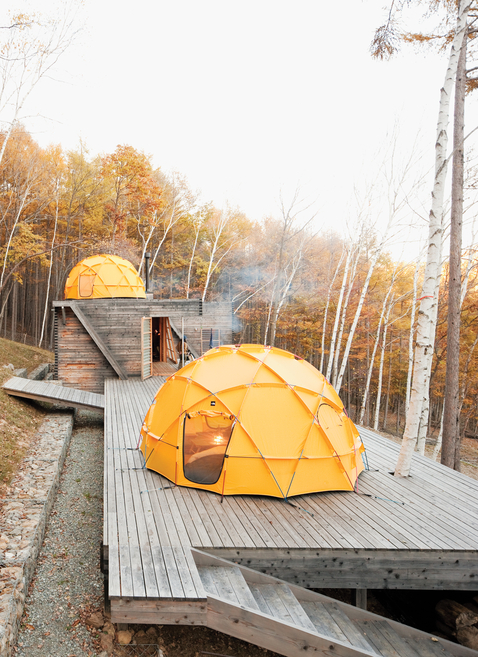
Setsumasa and Mami Kobayashi’s weekend retreat, two and a half hours northwest of Tokyo, is “an arresting concept,” photographer Dean Kaufman says, who documented the singular refuge in the Chichibu mountain range. “It’s finely balanced between rustic camping and feeling like the Farnsworth House.” Designed by Shin Ohori of General Design Co., the structure—Setsumasa bristles at the word “house,” since his desire was for something that
There are lots of handsome chairs out there, but sitting beauties that cost $250 or less are a rarer breed. Our picks run the gamut from traditional (the wooden, Shaker-inspired Salt or the Thonet-designed Era, the quintessential cafe chair) to the downright futuristic (we’re looking at you, oddly anthropomorphic Dr. Yes). We sat, swayed, shook, stacked; we hefted
Thomas Phifer is one of the most subdued architects you’ll ever meet. Sitting in his all-white New York office in a navy suit, reclining diagonally in a straight-backed chair, he speaks in a low and measured tone. When he’s being pensive—–which is most of the time—–he closes his eyes as he talks and bobs his hand gently in front of him like a conductor, as if coaxing out words. To hear him better, I lean in, block out the blaring car horns outside. In this way, he is like his architecture: exquisitely
When Svetlin Krastev and Dessi Nikolova had their second child, they saw two options: Go broke buying a bigger apartment, or renovate their existing 620-square-foot home. Because they loved their central Murray Hill location—Krastev can walk to work in 15 minutes, which means more time with his kids—and also because they themselves lived with their parents in tight quarters in Bulgaria, the decision came easily. However, to answer the not-so-simple question of how the space would work for four, they turned to Ferda Kolatan and Erich Schoenenberger of su11 architecture + design.
On a wooden platform in the middle of the village, dozens of young women gather, dressed in intricately embroidered aprons and jackets—the traditional costume of the Dong, one of the many ethnic minority groups of southwestern China. Nearby, a large group of villagers huddles around a bonfire. Everyone in Dimen, this tiny town about 400 miles northwest of Hong Kong, is preparing to celebrate the inscription of the Grand Song of the Dong onto UNESCO’s Intangible Cultural Heritage of Humanity list.
When Jay Atherton and Cy Keener met in grad school at the University of California, Berkeley, they discovered in each other a rare constellation of common interests: minimalist architecture, rock climbing, and “not talking.” After graduation, Atherton moved back to his hometown of Phoenix, Arizona, and purchased a downtown lot. Wanting to build a house, he asked Keener—a pro carpenter, then living in Colorado—to help with design and construction. Six months later, “His house became our house,” says Keener. “It became obvious the only way it would get built was if I shared the mortgage.” Atherton cackles: “I suckered him down here.”
Inspired by the Seinfeld episode where Kramer rescues a Merv Griffin Show set from the trash and sets it up in his living room, Rubin built a ’70s-style talk-show set in the back of the restaurant, aiming to “use waffles to lure people into public storytelling.”A dedicated host—sometimes one of Rubin’s students, sometimes a community member—sits at a desk
Outer Sunset, just south of Golden Gate Park, is a quiet, atmospheric neighborhood where thick fog frequently obscures the trim pastel houses, Asian groceries and surfers cycling down to Ocean Beach. Until recently, you’d never call it cool. But a hip and quirky micro-neighborhood has emerged, its epicenter at Judah Street and 45th Avenue, with a clutch of locally owned businesses bolstering a sense of community and drawing style seekers citywide.