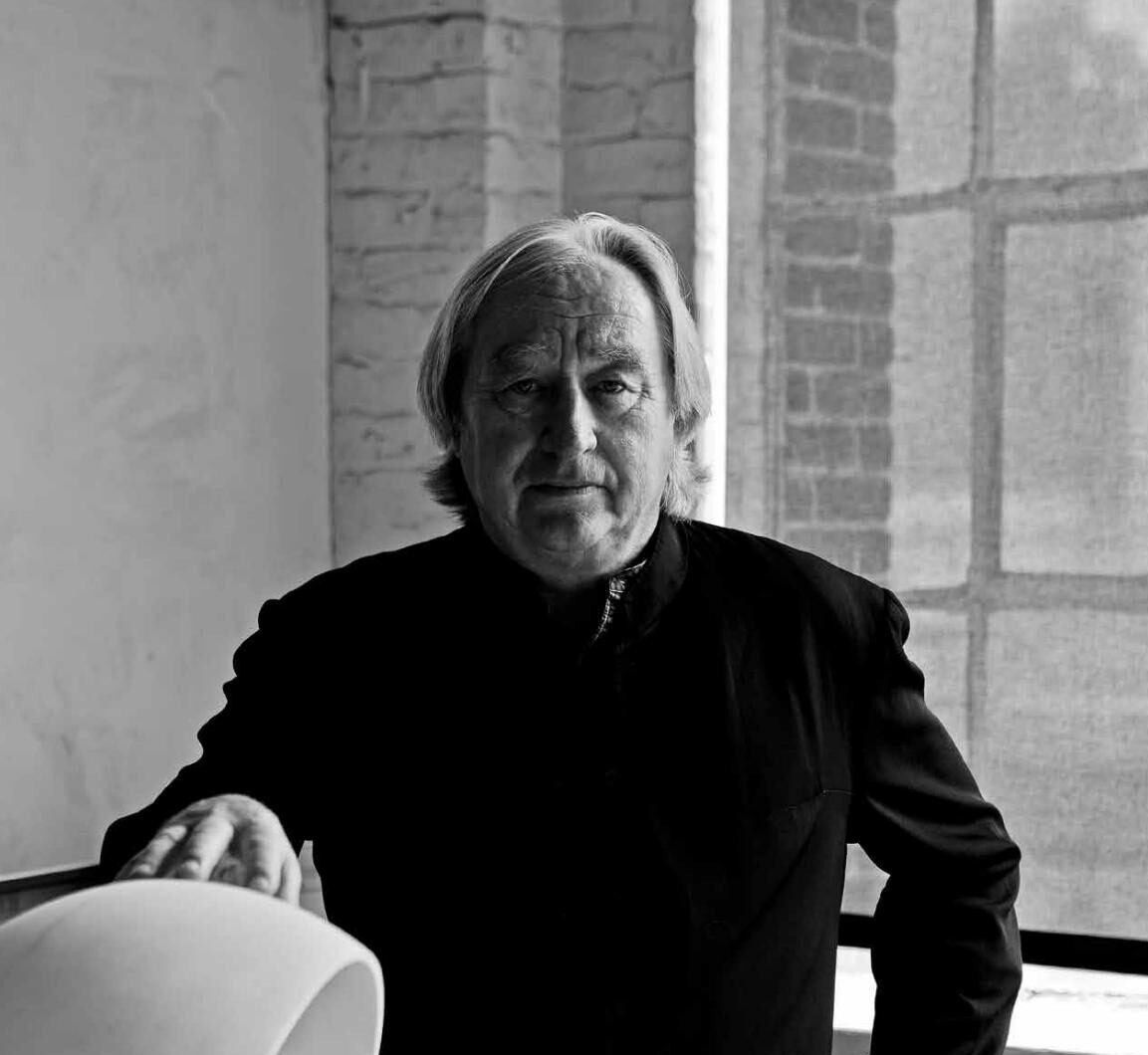
Legendary New York City–based architect and iconoclast Steven Holl pays tribute to the Northwest, the place where his obsession with light and space first took hold.
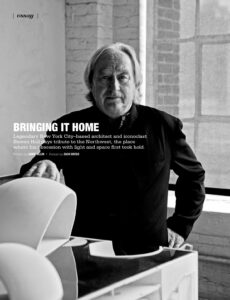
“Although I travel the world and have offices in New York, Beijing, and San Francisco, the Northwest is deeply ingrained in my being,” says architect Steven Holl, who grew up in the small waterfront towns of Bremerton and Manchester, Washington.
As a boy, long before he became one of the world’s most celebrated architects, he built model cities and ambitious clubhouses in his backyard. When he played on the beach in the winter, he noticed how the low-angled sun “glanced off Puget Sound to create a dappled effect.” These formative experiences gave him “a certain deep emotional connection to the changing seasons and the light of the sky”—a connection that continues to influence every building he designs.
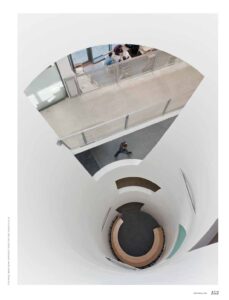
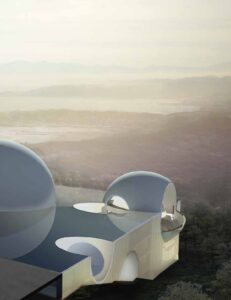
Today he and his international team of 39 designers shape buildings that break from architectural convention and take thrillingly new forms. His 2007 design for the Nelson-Atkins Museum of Art expansion in Kansas City consists of five glowing translucent glass boxes cascading down a grassy lawn; his 2009 Vanke Center is a 1.3-million-square-foot “horizontal skyscraper” hovering over a tropical garden in southern China. Holl’s firm continues to sweep the design field, winning a dizzying array of international competitions and prestigious commissions, including, most recently, an addition to the Museum of Fine Arts Houston and the expansion of the John F. Kennedy Center for the Performing Arts in Washington, D.C.
Despite his frenetic schedule—“We’ve got nine things under construction and nine things in design; we’ve never been so busy,” he says—Holl returns to his family’s Manchester cabin several times a year to recharge and reconnect with his roots. In a GRAY exclusive, the Northwest native son opens up his sketchbooks and family photo albums to trace his architectural origin stories.
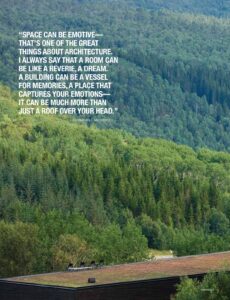
“SPACE CAN BE EMOTIVE—THAT’S ONE OF THE GREAT THINGS ABOUT ARCHITECTURE. I ALWAYS SAY THAT A ROOM CAN BE LIKE A REVERIE, A DREAM. A BUILDING CAN BE A VESSEL FOR MEMORIES, A PLACE THAT CAPTURES YOUR EMOTIONS—IT CAN BE MUCH MORE THAN JUST A ROOF OVER YOUR HEAD.”

I GREW UP ON THE BEACH IN YUKON HARBOR, WASHINGTON, BETWEEN BLAKE ISLAND AND MANCHESTER—which is a one-horse town where you can see the Space Needle and Seattle skyline across the bay. My brother and I fished for salmon and caught our limit every day, so much that we used to feed it to the dogs. My dad had a big garden. We had a life that was very anchored to the earth.
I respect the idea that where you’re born—especially if it’s by a large body of water facing the sunrise—shapes the rhythm of your life and your connection to the cosmos. The sense of open space, the freedom and freshness, that I felt as a child at the edge of beautiful Puget Sound has gotten into almost all my work. It drives my constant effort to engage water in my designs.
 The atmosphere of iconoclastic thinking in my family circle definitely influenced me early on. My godfather, William Vanderbilt, gave me books of Rilke poetry as soon as I’d learned to read. And my mom was really tough and single-minded—she didn’t take any bull from anybody. When she was pregnant with me, she was working for the ferry; she’d run 3,000 feet from our house down the boardwalk to take tickets and load cars onto the boat to Seattle. She went back to work two months after I was born. And later she was the head of tool control at the Puget Sound Naval Shipyard and had 40 people working under her. She was very rebellious, especially for a woman of the ’50s. She had her own checking account, and she would say, “We’re gonna do this, we’re gonna do that, and I’m paying for it.” She was the boss.
We had a big backyard at our house in Bremerton, and when I was six or seven years old, my brother Jim and I would spend hours “playing property.” We made hillside roads and model cities and a two-story tree house. Once we even built a clubhouse underground that we covered with logs and old carpets. Many years later, when I was teaching architecture at Columbia University, I made a diagram for the students. I told them there are only four types of architecture: under the ground, in the ground, on the ground, and over the ground. And that’s still part of how they teach architecture at Columbia. “Under, in, on, over”—it’s a basic first-year point. It sounds a bit far-fetched, but that idea started in the backyard when I was seven.
I always knew I wanted to be an architect. I loved to draw; I loved mathematics. When I was nine, my aunt had an architect draw up a modern house for her in Tacoma, and we went to visit. That was a bit of an influence. And a few years later, my mom took us to the 1962 World’s Fair in Seattle. We went to the top of the Space Needle, which was really impressive. You could see the whole fair from there, the monorail, the buildings they made; all that modern architecture was so optimistic. Something about those interesting experimental forms was really exciting to me.
My only doubts about architecture came when some of my architecture professors at the University of Washington were so stupid that I thought about switching my major to art. But I had a great teacher, Hermann Pundt, who told me, “Steven, you must apply to the Rome studies program.” He sent me a quote by Goethe that changed my life: “Rome is a city where one could spend a lifetime in Pythagorean silence and still not know it.” I thought, Wow, I gotta go.
I arrived in Rome as a college sophomore in 1970, very naïve and young and Pacific Northwestern. There’s something wrong with the Northwest. There’s a complacency you get—like, “This is the most beautiful place on earth.” Well, no, there are many places that are more interesting. But you don’t know that until you get out of there.
I was in Rome for 10 months studying under Astra Zarina, the first woman to win the Rome Prize. She was a professor at the University of Washington, she had a studio in Rome, and she spoke eight languages—an amazing woman. She told us that in order to be a great architect, the first thing you need to learn is how to cook. Color, texture, taste, smell, presentation; these things are all culturally connected to architecture. My Roman studies began with her handing me a big wooden bowl and spoon, green Italian olive oil, egg whites, and salt, and she made me stir it until it became mayonnaise.
I still teach at Columbia, and I teach students that thinking for yourself is the most important thing—and I mean thinking deeply, not in a superficial or reactionary way. There’s too much of that happening in design nowadays: a shallowness that’s promoted by Internet-speak and the Instagrammic method in which you see a plethora of images without depth. You type in a building and you get 100 images, yet they don’t even tell you who did it or where it is. This is the opposite of deep thinking. The upcoming generation needs to discipline themselves to not just surf and taste. Pundt said something very clearly: it’s more important to go into a building than to look at it. Not many buildings stand up to that test today. Some don’t have anything going on inside—they’re all about some Instagram image taken from the outside.
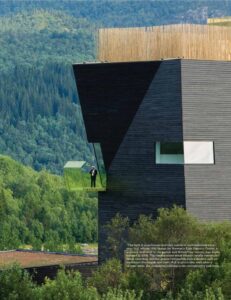
I’m very proud that my buildings don’t date, because they’re not stylistic. If you start designing with a stylistic or superficial trend, you’ll create something that gets very dated very fast. The Knut Hamsun Center in Norway, which I realized in 2009, was actually designed in 1994. It was put on hold for political reasons but then it opened, and I never changed a stick of the design. And it’s a building that looks good today. Its design was not about style. It was about that specific writer, that culture, that climate, that Norwegian landscape and its history. You have to think for a long time to do good architecture. We need more thinking all around in design.