Architect George Suyama takes “not in my backyard” to its (semi)logical extreme.
Five years after architect George Suyama, cofounder of Seattle’s acclaimed Suyama Peterson Deguchi, built himself and his wife a house in West Seattle, the lot next door came up for sale. It was a rare, undeveloped site with 50 feet of sandy private waterfront, its tiny cabin dwarfed by full-grown cedars. Most of the windows in his own house faced the neighboring lot, and he’d grown attached to the view. Terrified of what another buyer might build, he snapped it up. “It was an emotional investment more than a sound economic one,” he admits, and he had no specific action plan. Maybe he’d create a rental property or a guesthouse, or a residence designed to his liking that he could sell. But whatever he built, he knew two things: it would respect the existing trees, and it wouldn’t mess with his view.
Countless sketches and three full redesigns later, he settled in 2015 on a 2,000-square-foot building that’s 18 feet wide by 80 feet long, the biggest he could go without disturbing the existing trees. Inside, surface-nailed brown-stained plywood clads the ceiling and walls. “This house takes all the architectural detailing we usually do down to the most generic, simplistic methodology,” says Suyama. “In our main house, the detailing is fussy and expensive. In this house, it’s the opposite. There’s a lot more latitude for the imperfect.”
Suyama attributes this relaxed restraint to his age and experience as much as to the wisdom of not blowing the bank on a house that’s basically a pet project. “As I’ve gotten older, a certain flexibility has emerged. In your early days as a designer, you get fussed up and think you need everything a certain way. Once you’ve designed many houses, you realize you need some things and don’t need others. It harkens back to ancient Japanese potters who’d spend a lot of time making something perfect and then torque it. Once you can make it perfect, you can reach the next level. I couldn’t have done this house earlier in my career. I wouldn’t have had the wisdom.”
He knows it’s an unconventional building, but he wouldn’t have it any other way. “This’ll be a hard home to sell one day. Who’d want to live here?” he muses out loud (ignoring this writer’s raised hand), pondering whether he’ll ever see a return on his investment. For now, he and his wife are content to use it as the most convenient getaway ever, walking over to enjoy a glass of wine on the back porch or handing the key to lucky guests. They’ve even entertained the possibility of selling their main house and moving here. “The idea of living with less is very attractive,” he says. “Until you experience it, you don’t know what it feels like. It’s an incredible freedom.”
“IN YOUR EARLY DAYS AS A DESIGNER, YOU GET FUSSED UP AND THINK YOU NEED EVERYTHING A CERTAIN WAY. ONCE YOU’VE DESIGNED MANY HOUSES, YOU REALIZE YOU NEED SOME THINGS AND DON’T NEED OTHERS. I COULDN’T HAVE DONE THIS HOUSE EARLIER IN MY CAREER. I WOULDN’T HAVE HAD THE WISDOM.”
Captions:
-
From the home’s front entrance, you can see all the way to the 19-foot-high wall of windows at the back of the house. The protected porch nearly abuts a gigantic old cedar. Through its branches you can catch glimpses of glittering Puget Sound. “It’s counterintuitive to block the view of the water,” acknowledges Suyama. “But this wasn’t designed to be a house about view—it’s more about internal spaces and a relationship with nature. And yet the water’s always there, just beyond the tree. You can feel it. Not everyone gets the concept of withholding. Sometimes in withholding you find more power.”
-
The 1850s Japanese mizuya tansu chest has moved with the Suyamas from home to home over the past 30 years; the Noguchi pendant light hangs over a table that’s part of Suyama Peterson Deguchi’s 3×10 collection of custom furniture and décor.
-
Except for the white box that holds the home’s private spaces and stairwell, the rest of the house is open-plan. “Normally you’d divide a house into lots of separate spaces to respond to its program,” says Suyama. “But this house is so simple that you really can do only one clear gesture to maintain its conceptual clarity, and to hell with the rest of the program!”
-
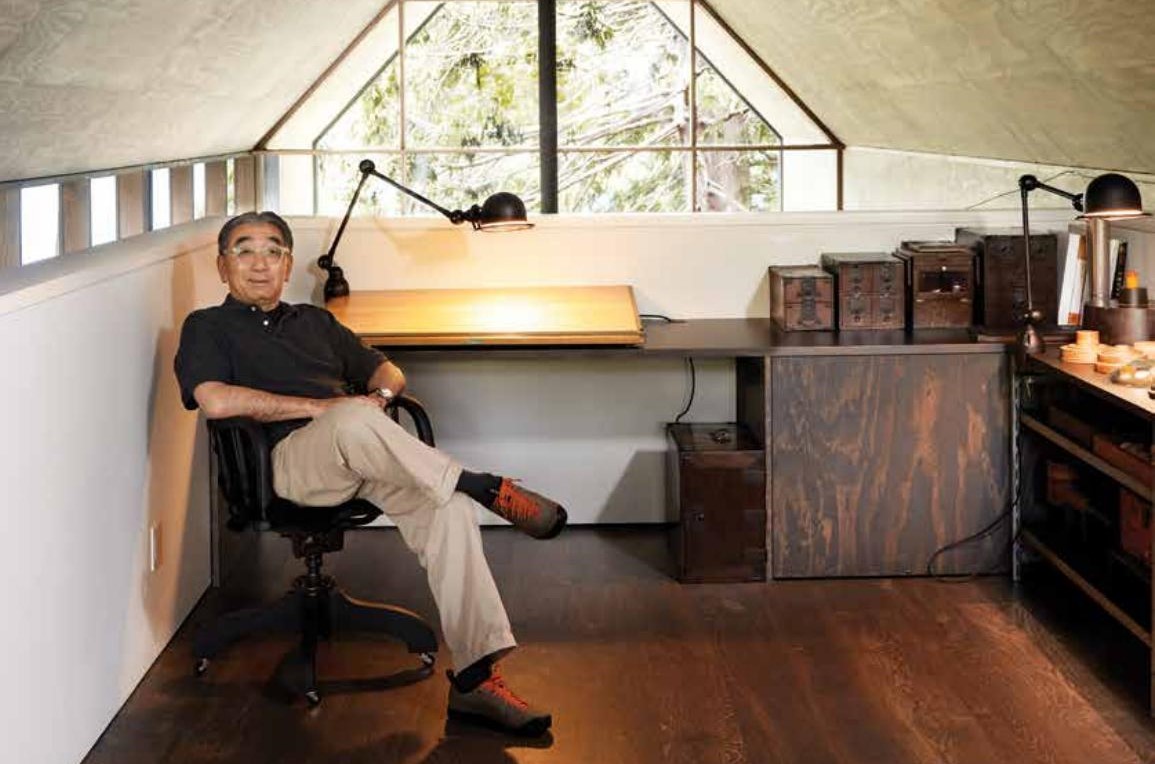
Suyama has filled the loft with some of his favorite objects—old fishing reels, tortoise shells, pocket watches, and other things he likes “shape-wise,” all arranged carefully on industrial shelving. The drafting table once belonged to the father of Suyama Peterson Deguchi’s cofounder, Jay Deguchi.
-
A 2-foot-wide slot runs down one side of the white box. When you stand in the kitchen and peer down the length of custom folded steel shelving, you can see past the bathroom sink to the bedroom windows 30 feet away. The slot “allows the house to breathe from one end to the other and gives you the feeling that the building is one simple shape,” says Suyama.
-
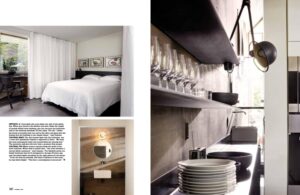
The slot funnels light into the bathroom, too, a room that epitomizes Suyama’s approach to décor. “We took the most economical tactic and reused what we already had.” The porcelain sink was left over from a previous firm project.
-
White canvas curtains flank the walls of the main bedroom. When they’re pulled shut, “the room becomes a surreal white sanctuary,” says Suyama. The Swedish prints are family heirlooms that he’d consigned to storage 40 years ago and unearthed while searching for the right pieces for the house. “Turns out they fit perfectly, and they’re fabulous in this room,” he says with delight. “That was a serendipitous turnaround.”