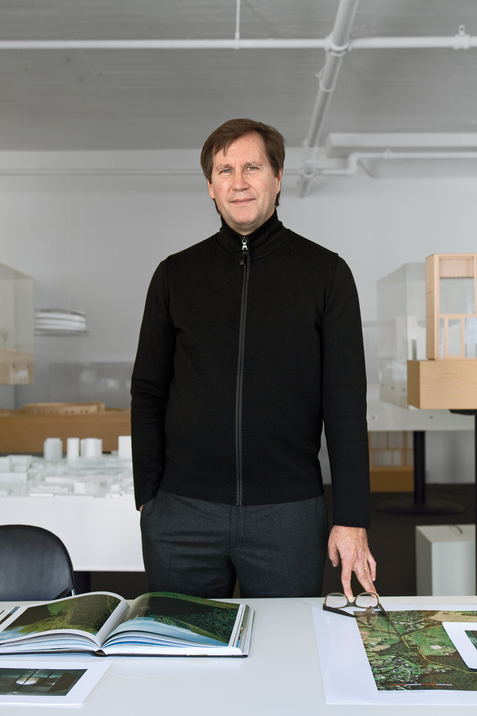
Don’t be fooled by his mellow, self-effacing demeanor: Architect Thomas Phifer is a master of his craft, designing daylit, minimalist buildings that meld the ideals of classic modernism with 21st-century innovations.
Thomas Phifer is one of the most subdued architects you’ll ever meet. Sitting in his all-white New York office in a navy suit, reclining diagonally in a straight-backed chair, he speaks in a low and measured tone. When he’s being pensive—–which is most of the time—–he closes his eyes as he talks and bobs his hand gently in front of him like a conductor, as if coaxing out words. To hear him better, I lean in, block out the blaring car horns outside. In this way, he is like his architecture: exquisitely (Read More…)
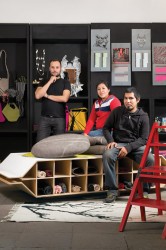
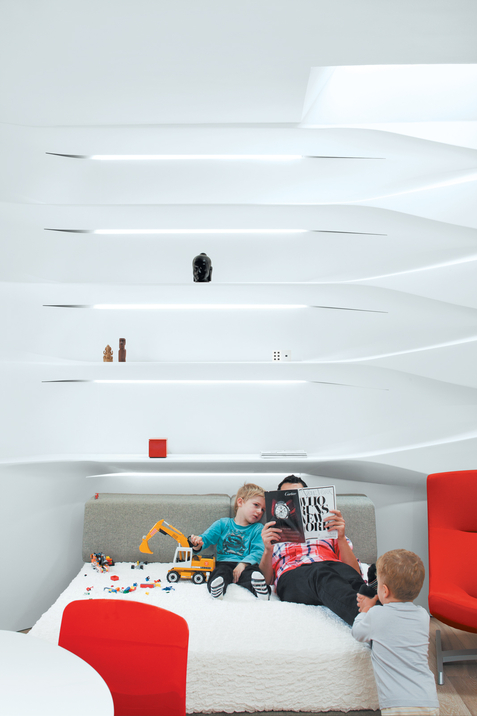
When Svetlin Krastev and Dessi Nikolova had their second child, they saw two options: Go broke buying a bigger apartment, or renovate their existing 620-square-foot home. Because they loved their central Murray Hill location—Krastev can walk to work in 15 minutes, which means more time with his kids—and also because they themselves lived with their parents in tight quarters in Bulgaria, the decision came easily. However, to answer the not-so-simple question of how the space would work for four, they turned to Ferda Kolatan and Erich Schoenenberger of su11 architecture + design.
Chris Houston, the charmingly curmudgeonly owner of Modern Artifacts in San Francisco, is not your typical retailer. Though his shop is packed to the rafters with an eclectic and highly covetable range of vintage furniture, lighting, art, and craft, Houston takes a slow and thoughtful approach to retail and commerce.
When Jay Atherton and Cy Keener met in grad school at the University of California, Berkeley, they discovered in each other a rare constellation of common interests: minimalist architecture, rock climbing, and “not talking.” After graduation, Atherton moved back to his hometown of Phoenix, Arizona, and purchased a downtown lot. Wanting to build a house, he asked Keener—a pro carpenter, then living in Colorado—to help with design and construction. Six months later, “His house became our house,” says Keener. “It became obvious the only way it would get built was if I shared the mortgage.” Atherton cackles: “I suckered him down here.”
Inspired by the Seinfeld episode where Kramer rescues a Merv Griffin Show set from the trash and sets it up in his living room, Rubin built a ’70s-style talk-show set in the back of the restaurant, aiming to “use waffles to lure people into public storytelling.”A dedicated host—sometimes one of Rubin’s students, sometimes a community member—sits at a desk
“Our fireplace is going through a bit of an awkward phase,” apologizes Anne Mooney, nodding at the hearth anchoring her family’s great room. It’s true: The shiny steel surface is mottled with constellations of orange-brown rust. The house’s exterior, too, is surprisingly mutable. Cor-Ten-steel scales arranged in a harlequin pattern cover the boxy, rectangular structure, which is nestled in a canyon eight miles east of downtown Salt Lake City, Utah. Exposed to the elements, the scales have rusted to a deep reddish brown. During warm weather, the cladding expands and crackles, “like it’s breathing,” says Mooney.
In construction-mad Beijing, “development happens at a crazy speed, like a tsunami,” says Matthew Xinyu Hu, the former managing director of the nonprofit Beijing Cultural Heritage Protection Center (BCHPC). This was especially evident in the lead-up to the 2008 Summer Olympics. The government poured more than $40 billion into improved infrastructure, razing much of the traditional urban fabric of the city in the name of modernization.
Gesturing at the wood-and-iron house he designed for his family three years ago, the Buenos Aires–based furniture designer and architect Alejandro Sticotti declares, “It was like putting in a UFO, like something from Mars.” True, with its clean lines, open floor plan, and raw finishes 
Few people would spend their life savings on a plot of land they’d never seen. Two exceptions are Adrienne Webb and Stefan Dunlop, who, while living in a loft in London, snapped up an acre of land in northeastern Australia, 10,000 miles away.